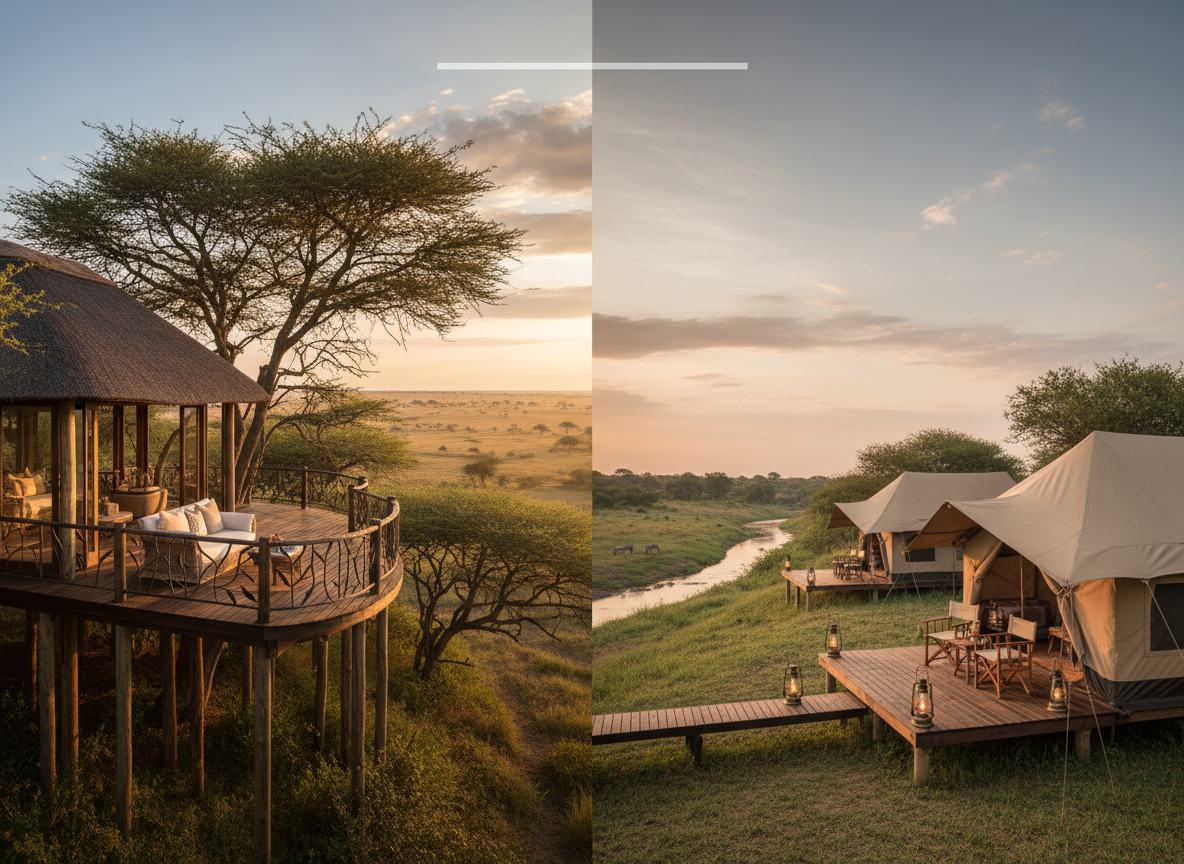
The Masai Mara offers two distinct architectural approaches to safari accommodation. One lifts you into the canopy or above the treeline; the other places you directly on the savannah, separated from passing wildlife by canvas walls. Choosing between a tree house lodge vs tented camp is not about which is better in an absolute sense. It is about which experience fits how you want to engage with the bush.
This guide compares both options across experience quality, wildlife proximity, photography, accessibility, and traveler fit.
Quick Comparison at a Glance
| Factor | Tree House / Elevated Lodge | Ground-Level Tented Camp |
|---|---|---|
| Elevation | 5 to 20 metres above ground | Ground level, wooden platform |
| Wildlife interaction | Aerial perspective, herd patterns visible | Eye-level with passing animals |
| Night sounds | Canopy: insects, owls, tree frogs | Ground: lions, hippos, hyenas close by |
| Photography | Overhead wildlife, landscape scale | Eye-level intimacy from tent deck |
| Accessibility | Stairs or ladders required | Flat access, boardwalk pathways |
| Weather | Wind exposure, cooler at height | Ground temperature, hotter at midday |
| Bush immersion | Above the landscape, not within it | Full sensory immersion |
| Availability | Limited; few Kenya properties offer this | Very common across the Masai Mara |
Elevated and Tree Lodge Stays in Kenya
What the Accommodation Looks Like
True tree lodges are rare in Kenya, which makes them distinctive when you find one. The Aberdare National Park has the oldest tradition: Treetops and The Ark were built to let guests watch wildlife at floodlit waterholes from elevated platforms. That tradition dates to 1932. In the greater Masai Mara ecosystem, a small number of properties incorporate elevated rooms or viewing decks that rise above the acacia line.
From that height, the experience changes. Sightlines extend to the horizon in every direction. Elephant herds become patterns of movement rather than individual encounters. Bird migration corridors open across the sky. Leopards resting in fig trees appear at eye level rather than above you. Dawn and dusk light hits the plains at angles only visible from above the canopy.
What Staying There Feels Like
Climbing to a room above the treeline changes the sensory register immediately. The sound profile shifts to wind, birds, and insects. Ground-level animal traffic, the kind that delivers an elephant between your tent and the next at midnight or a hippo outside your bathroom window, is not part of this experience. In its place is the sense of being suspended above the landscape. The sky feels more present. The spatial scale of the savannah is easier to take in all at once.
For photographers, the geometry of elevated shooting opens angles that ground-level positions cannot replicate. Herd movements, river bends, and open plains in morning light look very different from fifteen metres up.
Classic Tented Camps in the Masai Mara
What the Accommodation Looks Like
The standard Masai Mara safari stay is a luxury tented camp: individual canvas rooms on raised wooden platforms, positioned along the Mara River or on the plains edge. En-suite bathrooms, private verandas, and the sounds of the bush are constants throughout.
The defining quality is proximity. Animals move through tented camps at night. Elephants pass between tents. Hippos graze outside bathroom windows. Hyenas investigate kitchen areas after dark. You are on the ground; the ecosystem is on the same level. Canvas is not timber and platform. It is a permeable boundary between you and what lives out there.
The Immersion Factor
For most first-time and returning safari travelers, the ground-level tented camp delivers the experience that defines the Masai Mara. Waking to a lion calling at 3am from across the river. Hearing hippos in the channel beneath your veranda. Watching a giraffe browse an acacia ten metres from your tent during morning coffee. That sensory totality, the smell of the bush after rain, the specific sounds of the African night at ground level, is what the classic tented camp offers and what an elevated lodge cannot replicate in the same way.
Photography from the Ground
Ground-level tented camps offer strong photography opportunities in their own right. Eye-level shots of elephants, giraffes, and water birds from a tent veranda at sunrise produce some of the most intimate wildlife photographs possible. Game drive vehicles handle elevated and angled shots during excursions, while the camp itself provides ground-level encounters continuously throughout the day.
Tree House Lodge vs Tented Camp: How Wildlife Encounters Differ
| Wildlife | Elevated Lodge | Ground-Level Tented Camp |
|---|---|---|
| Elephants | Aerial view; herd geometry visible | Eye-level; trunk at eye height |
| Birds | Canopy level; raptors; migration patterns | Ground and water birds; dawn chorus |
| Leopards in trees | Eye level or above resting position | Looking up from below |
| Lions | Limited detail from height | Eye-level on plains from vehicle |
| Hippos | Pod patterns from above | Water surface level; closest from the bank |
| General wildlife | Landscape scale; movement patterns | Behavioral detail; close-range observation |
Neither approach is superior for all species or all moments. Elevated positions reward patience with birds and landscape-scale events. Ground-level access rewards behavioral observation and close encounters.
Accessibility and Physical Comfort
Elevated structures require guests to use stairs or ladders, sometimes over significant height changes between the main lodge and individual rooms. This makes them unsuitable for travelers with limited mobility, older guests who find stairs difficult, and young children.
Ground-level tented camps use flat-access boardwalk pathways between structures. Most quality Masai Mara camps can accommodate a wider range of mobility needs without adjustment.
Which Stay Fits Your Safari?
Choose a tree house or elevated lodge if you:
- Want an architecturally unusual stay that differs materially from a standard tented camp
- Are a photographer interested in landscape-scale and overhead wildlife perspectives
- Focus on bird species and want canopy-level access to hornbills, raptors, and tree-dwelling residents
- Have stayed in ground-level tented camps on previous safaris and want a contrasting experience
- Are visiting the Aberdares for the classic waterhole tree hotel tradition
Choose a ground-level tented camp if you:
- Want full bush immersion: animals walking through camp, ground-level night sounds
- This is your first or second safari and you want the defining Masai Mara canvas experience
- You are traveling with children, older guests, or anyone with mobility considerations
- Eye-level wildlife photography from your tent deck matters to your trip
- You are positioning near the Mara River for wildebeest crossing access
For most Masai Mara safaris, the ground-level tented camp remains the more complete introduction to what the ecosystem offers. Elevated lodges are worthwhile as a contrasting stay, particularly for return visitors or those with a specific photography or birdwatching focus.
Explorer Notes
- True tree lodges in the Masai Mara ecosystem are limited. Verify what “elevated” means before booking: some lodges use that language for rooms one or two floors above ground, which differs from a genuine canopy structure.
- Wind exposure at height matters more than most travelers anticipate. Cooler temperatures at elevation are welcome in the hot season but uncomfortable in July and August.
- If combining both accommodation styles in one itinerary, consider doing the ground-level tented camp first. The immersion experience sets the baseline; the elevated lodge then reads as a genuine contrast rather than a reduction in wildlife proximity.
- The Aberdares tree hotels (Treetops, The Ark) operate on a specific overnight format: guests arrive in the afternoon, observe at the floodlit waterhole through the night, and depart in the morning. This differs from a standard multi-night elevated lodge stay in the Masai Mara ecosystem.
Choosing Your Perspective
Both accommodation styles work well in Kenya when matched to the right traveler. The distinction comes down to what the experience prioritizes. Ground-level tented camps place you inside the ecosystem, where sounds and animals arrive at the same level you sleep. Elevated lodges place you above it, where scale and light and aerial movement become the dominant impressions. The choice depends on whether you want to be within the landscape or to survey it.
Have questions about this itinerary or destination? Get answers from a safari specialist before you commit.
Inquire More